

If the California Employment Development Department has scheduled an employment tax interview as part of your payroll tax audit, preparation matters.
The interview gives the EDD auditor an opportunity to understand how your business operates, how your accounting and payroll systems work, who performs services for the business, and how employees and independent contractors are treated.
What you say should be accurate and consistent with your records. The goal is not to avoid legitimate questions, but to understand the issues before the meeting so you can provide clear, factual information rather than guesses or incomplete explanations.
This guide explains what an EDD employment tax interview is, the kinds of topics that may be discussed, how worker classification can become part of the interview, and what California employers should review beforehand.
What Is an EDD Employment Tax Interview?
EDD guidance provides for an entrance interview before the auditor begins reviewing the employer's records. The interview may be conducted with the employer or an authorized representative.
The purpose of the interview includes:
- Explaining the purpose of the audit and the audit process
- Learning how the business is organized and operated
- Understanding the accounting and payroll systems
- Identifying the types of services performed by employees
- Understanding how and why independent contractors are used
- Clarifying filing, withholding, and payroll tax practices
- Identifying areas that may require additional records or explanation
The interview can therefore shape the auditor's understanding of the business before the detailed records examination begins.
Why the EDD Interview Matters
Accounting records show how payments were recorded, but they do not always explain how a business actually operates.
The interview gives the auditor context for the records. Statements about who performs services, how workers are supervised, how contractors are selected, how workers are paid, and how payroll is processed may affect what the auditor decides to examine more closely.
That is particularly important when the business uses independent contractors or has significant payments outside regular payroll.
What Questions May the EDD Ask During the Interview?
The exact questions depend on the business and the audit. Common areas of discussion can include:
- The legal structure and ownership of the business
- The nature of the business and services provided
- How payroll is processed
- Who maintains the accounting records
- The number and types of workers used by the business
- Whether the business uses independent contractors or subcontractors
- How employees and contractors are paid
- What services independent contractors perform
- Who determines schedules or work assignments
- Who provides tools, equipment, or materials
- Whether workers perform services for other businesses
- Whether written agreements exist with contractors
- How contractor payments are recorded in the general ledger
- Whether there have been changes in ownership, payroll systems, or business structure
The auditor may also ask follow-up questions after reviewing the records if additional issues arise.
Worker Classification Questions Can Be Especially Important
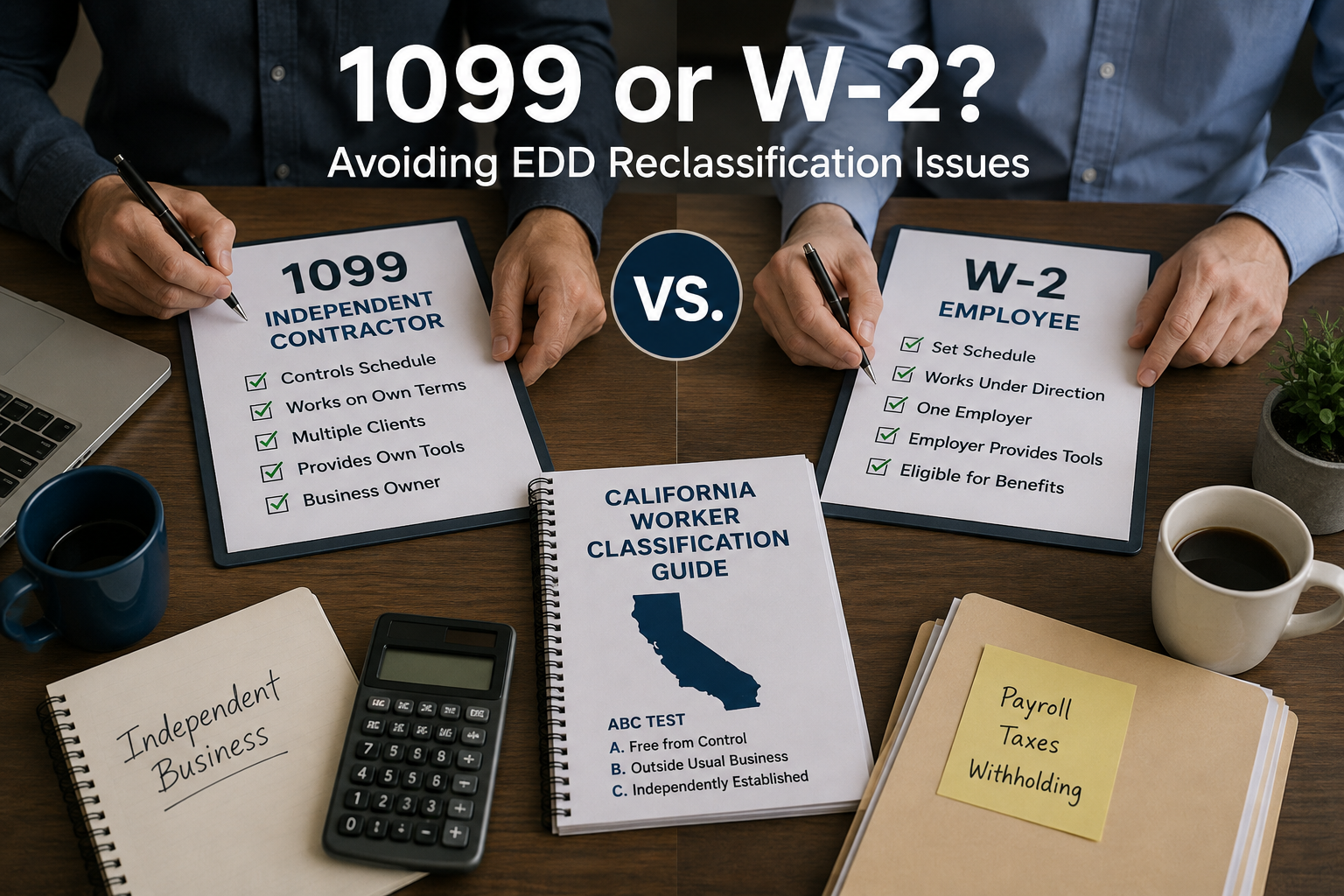
California worker classification rules are a major issue in many EDD employment tax audits.
If the business uses independent contractors, the auditor may want to understand the actual relationship between the business and those workers rather than relying solely on Forms 1099 or written agreements.
California generally uses the ABC test for many workers. When that test applies, the hiring entity must establish all three required conditions for independent contractor treatment. Certain statutory exceptions can result in application of the Borello multifactor test or another applicable standard.
EDD's current employer guidance specifically warns that incorrectly classifying employees as independent contractors can result in back taxes, penalties, and interest.
For a deeper explanation, see our California EDD Worker Classification Audit Guide.
What Should You Review Before the EDD Interview?
Before the meeting, review enough information to understand how your payroll and contractor systems actually work.
Useful areas to review include:
- The EDD audit notice and audit period
- The initial records request
- Payroll registers and payroll tax returns
- Forms W-2 and 1099
- General ledger payroll and contractor accounts
- Independent contractor agreements
- Invoices and contractor payment records
- How workers are supervised and scheduled
- Who provides tools or equipment
- Whether contractors maintain separate businesses
- How owners and corporate officers are compensated
- Any known inconsistencies between payroll and accounting records
What Documents Should You Have Available?
The auditor's actual request controls what must be produced. However, documents commonly relevant to an EDD payroll tax examination may include:
- California payroll tax returns
- Payroll registers and payroll journals
- Forms W-2 and W-3
- Forms 1099
- General ledgers
- Financial statements
- Federal and California income tax returns
- Check registers and disbursement records
- Independent contractor agreements
- Invoices and supporting payment documentation
- Information concerning the services performed by workers
You do not need to bring every document your business has simply because an interview is scheduled. Review the EDD's request and understand what is responsive.
How Should You Answer the Auditor's Questions?
The most important rule is simple: be accurate.
You should not speculate about facts you do not remember or make assumptions about records you have not reviewed.
Good practices include:
- Listen carefully to the question being asked
- Answer the actual question rather than a different question
- Use business records when the answer depends on accounting data
- Distinguish what you know from what you assume
- Ask for clarification if a question is unclear
- Verify information when you do not know the answer
- Avoid guessing about dates, amounts, or historical practices
- Correct an answer if you later discover that it was inaccurate
An accurate answer after reviewing the records is generally more useful than an immediate answer based on memory alone.
Common Mistakes to Avoid During an EDD Employment Tax Interview
Guessing About Facts
If you do not remember a historical fact or payment amount, review the records before providing an answer.
Describing Workers Only by Their Tax Forms
Saying that someone was a contractor simply because the business issued a Form 1099 does not answer the classification question. The auditor may need to understand how the relationship actually worked.
Failing to Review Contractor Accounts
If the general ledger contains substantial outside labor, subcontractor, commission, or contractor accounts, understand who received those payments and what services they performed before the interview.
Providing Inconsistent Explanations
Differences between what the business owner says, what the bookkeeper says, and what the records show can create additional questions. Review the underlying facts before the meeting.
Treating the Interview as an Informal Conversation
The interview is part of the audit process. Questions and answers may influence the direction of the examination, so the discussion should be approached professionally and accurately.
Can You Have a CPA Represent You During an EDD Audit?
Yes. A taxpayer may use an authorized representative in appropriate EDD employment tax matters.
Depending on the circumstances, CPA representation may include:
- Reviewing the EDD audit notice before the interview
- Reviewing the auditor's records request
- Identifying likely worker classification issues
- Reviewing payroll and accounting information
- Helping the business understand the questions likely to arise
- Communicating with the auditor
- Participating in audit meetings when appropriate
- Following up with records or explanations requested during the interview
Representation does not mean preventing the EDD from obtaining legitimate information. It means helping ensure the audit is handled in an organized, accurate, and professional manner.
What Happens After the EDD Interview?
After the entrance interview, the auditor generally proceeds with the records examination.
Questions raised during the interview may lead to requests for additional information concerning payroll, contractor payments, worker relationships, or accounting records.
If worker classification is a major issue, the audit may require additional factual development regarding the individuals or groups of workers under examination.
For an overview of what happens during the remainder of the examination, see our California EDD Payroll Tax Audit Guide.
What if the Interview Reveals a Potential Problem?
Discovering a potential classification or reporting issue during the interview does not necessarily determine the final audit result.
It may mean that additional work is needed to:
- Review the applicable worker classification standard
- Develop the factual history of the worker relationship
- Locate contracts, invoices, or payment records
- Reconcile accounting and payroll information
- Identify which workers and periods may be affected
- Correct misunderstandings concerning business operations
The important point is to address the issue based on the facts and records rather than assuming the auditor's initial concern will necessarily become the final assessment.
EDD Employment Tax Interview Preparation Checklist
- Read the audit notice. Know the audit period, auditor, scheduled meeting date, and requested records.
- Understand your payroll system. Be prepared to explain how payroll is processed and who maintains the records.
- Review your workforce. Identify employees, independent contractors, subcontractors, commissioned workers, officers, and other service providers.
- Review contractor payments. Know who received Forms 1099 and what services those individuals or businesses performed.
- Review worker relationships. Understand how work was assigned, supervised, scheduled, and performed.
- Review the accounting records. Identify contractor, outside labor, payroll, commission, and similar general ledger accounts.
- Identify discrepancies. Understand significant differences among payroll records, Forms W-2 and 1099, tax returns, and the general ledger.
- Do not guess. Know which questions require review of records before they can be answered accurately.
- Consider representation. If the audit involves substantial contractor payments, classification disputes, missing records, or significant potential liability, professional representation may be appropriate.
CPA Representation for an EDD Employment Tax Interview
Boulanger CPA and Consulting PC provides CPA-led representation for California businesses facing EDD payroll tax audits and worker classification examinations.
We can help review the audit notice, understand the scope of the examination, evaluate payroll and contractor records, prepare for the entrance interview, communicate with the auditor, and address issues that develop as the audit continues.
Based in Orange County, we represent California businesses statewide through secure virtual meetings and by-appointment office visits.
Has the EDD Scheduled Your Employment Tax Interview?
We can review the notice, identify potential payroll and worker classification issues, and help you prepare for the meeting before the audit moves forward.
Schedule an EDD Audit ConsultationFrequently Asked Questions About EDD Employment Tax Interviews
What is an EDD employment tax interview?
The EDD entrance interview is part of the employment tax audit process. It gives the auditor an opportunity to explain the examination and learn about the business, accounting records, payroll system, workers, and general operations.
What questions does the EDD ask during an audit interview?
Questions vary by business but may involve ownership, business operations, payroll procedures, accounting records, employees, independent contractors, payment methods, worker supervision, and contractor relationships.
What documents should I review before the EDD interview?
Relevant records may include payroll registers, payroll tax returns, Forms W-2 and 1099, general ledgers, contractor agreements, invoices, payment records, tax returns, and other documents related to the workers or issues under examination.
Can the EDD ask questions about my independent contractors?
Yes. Worker classification is an important part of many EDD payroll tax audits. The auditor may ask about the services contractors perform, how they are supervised, how they are paid, and how their businesses operate.
What should I do if I do not know the answer to an auditor's question?
Avoid guessing. If an accurate response requires reviewing records or verifying historical information, it is generally better to research the facts and provide an accurate response.
Can a CPA represent me during an EDD audit interview?
A taxpayer may use an authorized representative in appropriate EDD employment tax matters. A CPA can assist with audit preparation, accounting and payroll records, worker classification issues, auditor communications, and audit meetings.
What happens after the EDD entrance interview?
The auditor generally proceeds with the records examination. Information learned during the interview may lead to additional records requests or further review of payroll, contractor payments, or worker classification issues.