
California Employment Development Department payroll tax audits can begin for a variety of reasons. Sometimes the EDD is examining a specific worker classification issue. In other cases, the audit may involve payroll reporting, payments to independent contractors, discrepancies in business records, or information obtained through the EDD's compliance activities.
Receiving an EDD audit notice does not necessarily mean the Department has already concluded that your business owes additional tax. But once an audit begins, the EDD may review payroll records, Forms W-2 and 1099, accounting records, worker relationships, and other information to determine whether California employment taxes were properly reported.
This guide explains some of the issues that can lead to EDD scrutiny, what the auditor may examine, and what California business owners should consider after receiving an audit notice.
What Is the EDD Looking for During a Payroll Tax Audit?
The EDD administers and enforces California employment tax requirements involving:
- Unemployment Insurance (UI)
- Employment Training Tax (ETT)
- State Disability Insurance (SDI)
- Personal Income Tax (PIT) withholding
According to the EDD's Employment Tax Audit Process guidance, an audit is intended to verify compliance with California employment tax law, determine whether workers were properly classified, and confirm that payments to employees were properly reported.
EDD employment tax audits generally cover a three-year statutory period consisting of the 12 most recently completed calendar quarters. The EDD may begin by examining a test year, usually the most recently completed calendar year, and may expand the examination when appropriate.
Common Issues That Can Lead to an EDD Payroll Tax Audit
1. Independent Contractors and Worker Classification
Worker classification is one of the most important issues examined in EDD payroll tax audits.
If a business makes significant payments to individuals who are treated as independent contractors rather than employees, the EDD may examine whether those workers were properly classified under California law.
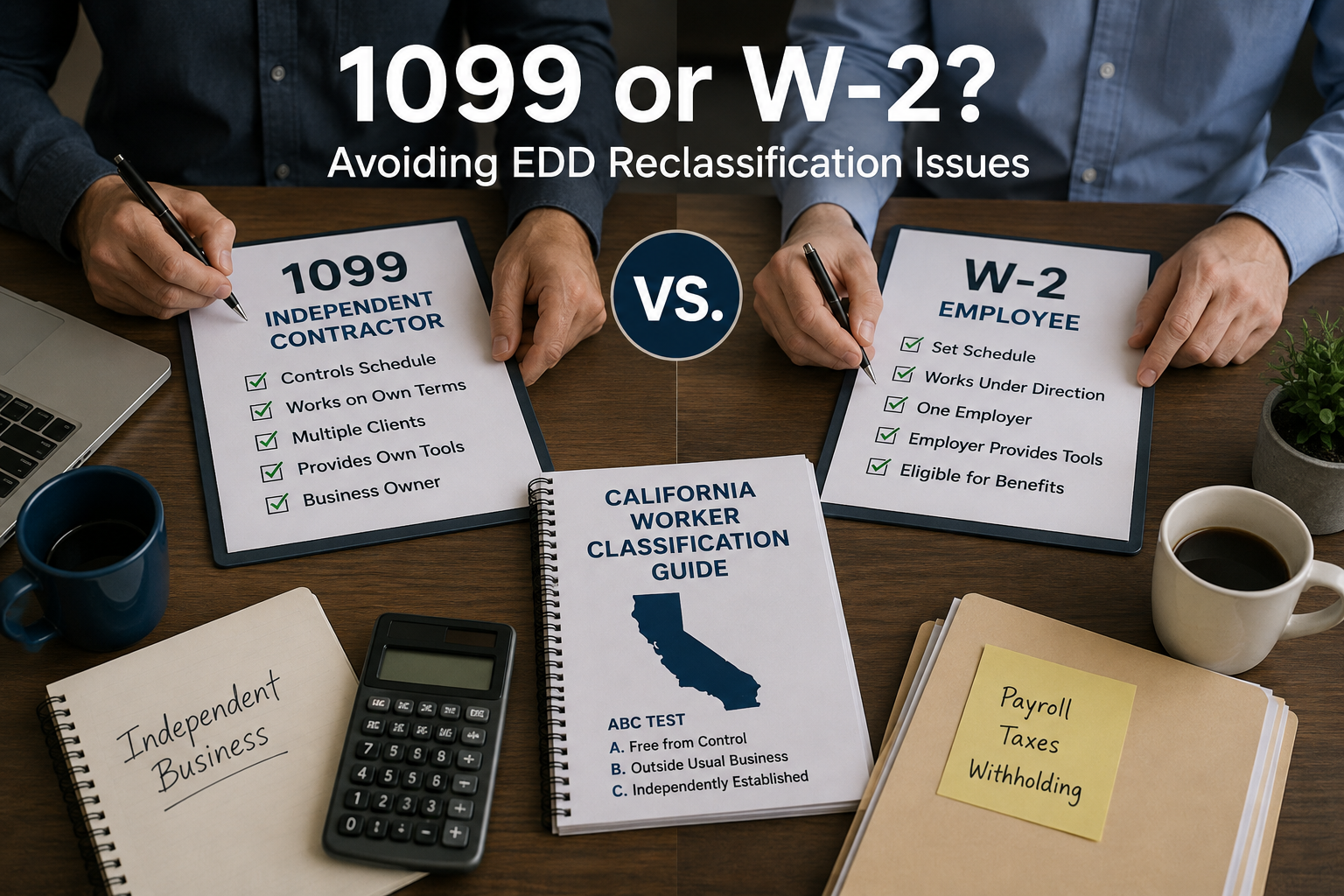
A Form 1099 or independent contractor agreement does not by itself determine worker status. Depending on the worker and the services involved, the EDD may apply California's ABC test or another applicable classification standard.
When the ABC test applies, a worker is generally treated as an employee unless the hiring entity can establish all three required conditions. California law also contains exceptions for certain occupations and business relationships.
Learn more in our EDD Worker Classification Audit Guide.
2. Information Concerning a Worker or Employment Relationship
Information about a worker's employment relationship can bring classification or payroll reporting issues to the EDD's attention.
For example, a worker who was treated as an independent contractor may later seek unemployment benefits or otherwise raise questions about whether the relationship was actually employment. The EDD also provides procedures for requesting a preliminary worker classification assessment or submitting an audit lead referral.
When worker status becomes an issue, the Department may examine how the individual actually performed services rather than relying solely on contracts or tax forms.
3. Payroll Tax Filing or Reporting Problems
Missing, late, inconsistent, or inaccurate payroll tax filings can create questions about whether all wages and employment taxes were properly reported.
California employers commonly file forms including:
- Quarterly Contribution Return and Report of Wages (DE 9)
- Quarterly Contribution Return and Report of Wages Continuation (DE 9C)
- Payroll Tax Deposit (DE 88)
- Report of New Employee(s) (DE 34)
- Report of Independent Contractor(s) (DE 542), when applicable
Differences among payroll returns, W-2 reporting, accounting records, or other business information can become relevant during an examination.
4. Significant Payments Outside Regular Payroll
Payments recorded outside the regular payroll system may receive additional attention during an EDD audit, particularly when those payments were made to individuals performing services for the business.
The auditor may review general ledger accounts, check registers, Forms 1099, invoices, and other disbursement records to determine whether payments treated as nonemployee compensation should instead have been reported as wages.
5. Large or Recurring Independent Contractor Payments
A business that regularly uses independent contractors may face additional worker classification questions during an audit.
The EDD may consider issues such as:
- What services the contractor performed
- Whether those services were part of the business's usual operations
- How much direction or control the business exercised
- Whether the worker operated an independently established business
- How similarly situated workers were treated
6. Information From Other Tax or Government Records
During an employment tax examination, the EDD may compare payroll reporting with other tax and financial records. Information from other government reporting systems may also identify discrepancies that require explanation.
This is one reason payroll returns, income tax returns, Forms W-2 and 1099, general ledger accounts, and related records should be reviewed together rather than in isolation.
What Happens After an EDD Audit Begins?
The EDD generally begins the examination by notifying the business and identifying records it wants to review.
Before examining the records, the auditor normally conducts an entrance interview with the employer or the employer's representative. According to EDD guidance, the purpose includes explaining the audit process, learning about the business and its accounting system, and gathering general information about its operations.
Records requested may include:
- Payroll registers and payroll tax returns
- Forms W-2 and 1099
- General ledgers and financial statements
- Federal and California income tax returns
- Check registers and other disbursement records
- Independent contractor agreements and invoices
- Documents concerning worker relationships and services performed
For a broader overview, see our California EDD Payroll Tax Audit Guide.
Can an EDD Audit Expand Beyond the Initial Review?
Yes. EDD guidance explains that an audit commonly begins with a test year but may expand to the entire statutory audit period when the circumstances warrant it.
In some situations, the examination may extend beyond the ordinary three-year period. The exact scope depends on the facts, filing history, and issues under examination.
This is why identifying potential problems early can be important. A classification or reporting issue discovered in the test period may lead the auditor to examine similar transactions or workers in additional periods.
What Happens if the EDD Reclassifies Independent Contractors?
If the EDD determines that workers treated as independent contractors should have been employees, payments to those workers may be treated as wages for California employment tax purposes.
Depending on the facts and periods involved, the resulting assessment may include additional employment taxes, interest, and applicable penalties.
The effect can become significant when the same classification practice was used for multiple workers or continued for several years.
Can You Prevent an EDD Audit?
There is no way to guarantee that a business will never be audited. The better objective is to maintain payroll and worker records that allow the business to respond effectively if an examination occurs.
Good practices include:
- Evaluate worker classification under the applicable California standard
- File payroll tax returns and wage reports accurately and on time
- Report independent contractors when required
- Maintain contracts, invoices, payroll records, and payment documentation
- Keep accounting records consistent with payroll and tax reporting
- Review unusual or substantial payments made outside payroll
- Address payroll reporting errors rather than allowing them to accumulate
What Should You Do if You Receive an EDD Audit Notice?
An EDD audit notice should be reviewed before large volumes of payroll and accounting records are produced.
Important early steps include:
- Confirm the audit period
- Review the records the auditor is requesting
- Identify independent contractors and other nonemployee payments
- Review payroll and general ledger accounts for inconsistencies
- Identify possible worker classification questions
- Organize the requested records before production
- Understand upcoming deadlines and the stage of the examination
The objective is not to withhold legitimate information. It is to make sure the business understands its own records and potential issues before those records become part of the audit.
CPA Representation for California EDD Payroll Tax Audits
Boulanger CPA and Consulting PC represents California businesses facing EDD payroll tax audits, worker classification disputes, independent contractor examinations, assessments, and appeals.
Representation may include reviewing the audit notice, communicating with the auditor, organizing payroll and accounting records, evaluating worker classification issues, reviewing proposed adjustments, and helping challenge disputed audit findings when appropriate.
Based in Orange County, we represent businesses throughout California through secure virtual meetings and by-appointment office visits.
Frequently Asked Questions About EDD Payroll Tax Audit Triggers
What triggers an EDD payroll tax audit?
There is no single trigger for every audit. Worker classification issues, independent contractor payments, payroll reporting inconsistencies, information concerning workers, and other compliance issues may bring a business under EDD examination.
Does having independent contractors mean I will be audited?
No. Using independent contractors does not automatically result in an audit. However, worker classification can become an important issue if the EDD examines the business, particularly when substantial or recurring payments are made to individuals outside payroll.
How far back does an EDD payroll tax audit usually go?
EDD guidance states that employment tax audits generally cover a three-year statutory period consisting of the 12 most recently completed calendar quarters. The examination may be expanded and, in some circumstances, may extend beyond that period.
What records will the EDD request?
The records depend on the audit, but they may include payroll records, payroll tax returns, Forms W-2 and 1099, general ledgers, financial statements, income tax returns, payment records, contractor agreements, invoices, and information concerning worker relationships.
Can one contractor classification issue affect other workers?
Potentially. If multiple workers performed similar services under similar arrangements, an auditor may examine whether the same classification issue applies to other workers or periods.
Should I hire a CPA when I receive an EDD audit notice?
A CPA can represent a business in appropriate EDD payroll tax matters and can help review accounting and payroll records, communicate with the auditor, evaluate worker classification questions, and review disputed audit adjustments.