

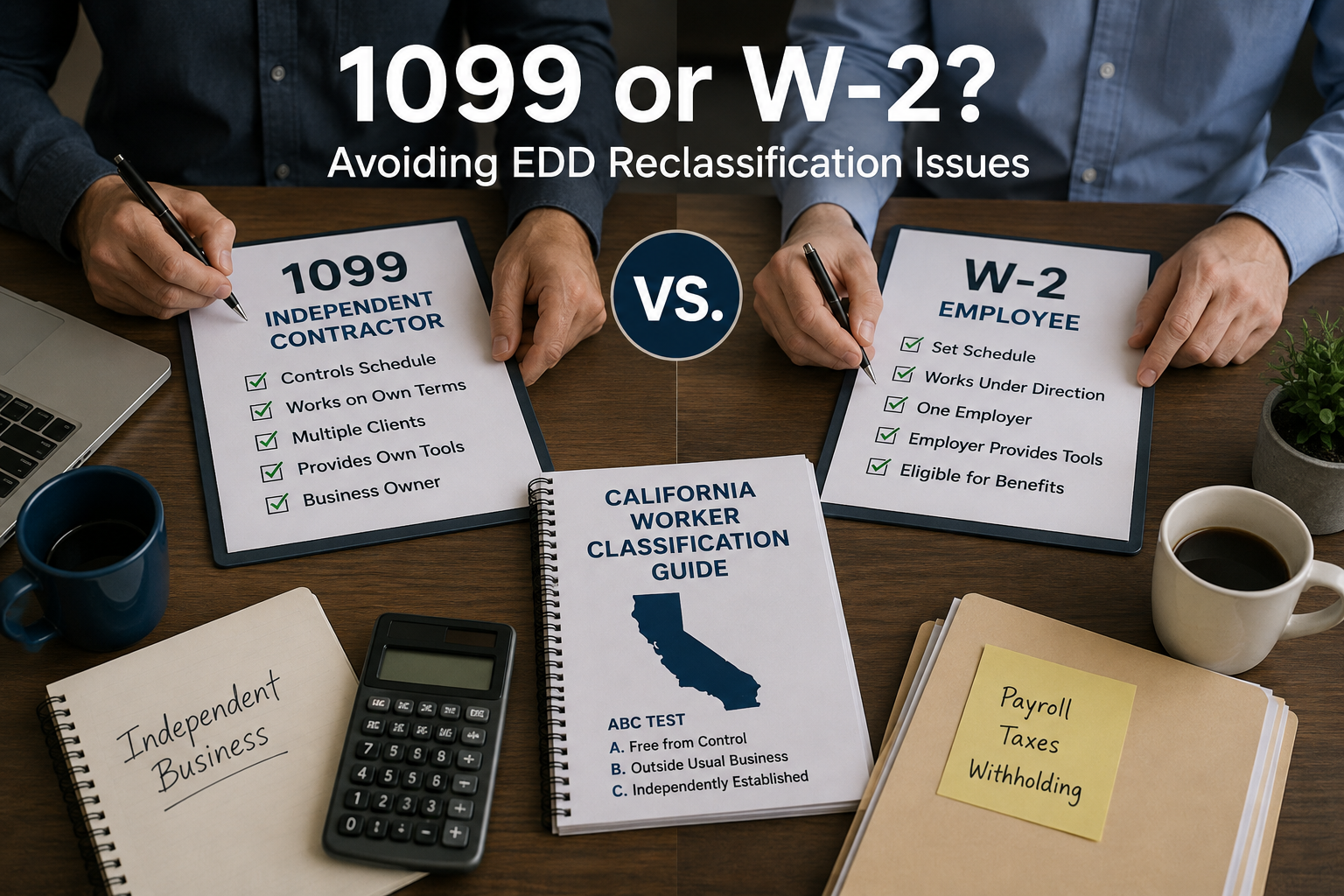
California worker classification can become one of the most significant issues in an Employment Development Department payroll tax audit.
A business may consider someone an independent contractor, issue that person a Form 1099, and still face an EDD determination that the worker should have been treated as an employee for California employment tax purposes.
When that happens, payments previously treated as nonemployee compensation may be treated as wages, potentially resulting in additional employment taxes, interest, and applicable penalties.
This guide explains the difference between tax reporting and legal worker classification, how California's ABC test works, when another classification standard may apply, what the EDD may review during an audit, and how businesses can evaluate contractor relationships before they become an audit problem.
What Is the Difference Between a 1099 Contractor and a W-2 Employee?
Forms W-2 and 1099 describe how payments were reported for tax purposes. They do not, by themselves, determine whether a worker was legally an employee or independent contractor.
W-2 Employees
When a worker is an employee, the employer generally has California payroll reporting and withholding responsibilities.
Depending on the employment and applicable tax rules, those responsibilities may include:
- Reporting wages to the EDD
- Withholding California Personal Income Tax when required
- Withholding employee State Disability Insurance contributions when applicable
- Paying employer Unemployment Insurance contributions
- Paying Employment Training Tax when applicable
- Filing required California payroll tax returns
- Issuing Form W-2 for employee wages
Independent Contractors
A true independent contractor generally operates a separate business and is not treated as an employee for the services at issue.
Payments may be reportable on Form 1099-NEC and may also create California independent contractor reporting requirements.
The critical point is that issuing a Form 1099 does not create independent contractor status. The actual working relationship must satisfy the classification standard that applies under California law.
California's ABC Test for Worker Classification
For many California worker relationships, the ABC test is the starting point.
Under the ABC test, an individual providing labor or services for compensation is generally considered an employee unless the hiring entity can establish all three of the following conditions:
A. Freedom from control and direction
The worker must be free from the hiring entity's control and direction in connection with performing the work, both under the contract and in actual practice.
B. Work outside the usual course of the hiring entity's business
The services performed must be outside the usual course of the hiring entity's business.
C. Independently established business
The worker must be customarily engaged in an independently established trade, occupation, or business of the same nature as the work being performed.
If all three conditions are not met, the worker is generally treated as an employee unless a statutory exclusion or exception applies.
Does the ABC Test Apply to Every California Worker?
No. California law contains a number of statutory exceptions to the ABC test.
Depending on the occupation, industry, and business relationship involved, a different standard may apply. In some situations, the Borello multifactor test is used instead of the ABC test.
This is why worker classification should not be reduced to a checklist without first determining which legal standard applies.
For a broader discussion, see our California EDD Worker Classification Audit Guide.
Does an Independent Contractor Agreement Protect You?
A written independent contractor agreement can be useful evidence of the parties' intended relationship, but it does not control the classification result by itself.
The EDD may compare the written agreement with what actually occurred.
For example, a contract may say the worker controls how the work is performed, while the actual business arrangement may show something different.
The underlying facts matter more than the label placed on the relationship.
What Does the EDD Review When Questioning a 1099 Worker?
During a payroll tax audit, the EDD may examine both financial records and information concerning the actual working relationship.
Relevant records and facts may include:
- Forms 1099 and contractor payment records
- Independent contractor agreements
- Invoices
- General ledger contractor and outside labor accounts
- How the worker was paid
- The services the worker performed
- Who assigned or directed the work
- Whether the worker provided tools or equipment
- Whether the worker maintained a separate business
- Whether the worker provided similar services to other customers
- Whether the services were part of the hiring entity's usual business
- How similarly situated workers were treated
Worker Classification Issues That Deserve a Closer Look
No single fact automatically makes a worker an employee in every situation. However, certain arrangements should cause a business to review the classification more carefully.
The Worker Performs the Same Services as the Business
When the ABC test applies, whether the worker performs services outside the usual course of the hiring entity's business is specifically part of the analysis.
The Business Closely Directs the Work
Significant control over how work is performed can create classification concerns, although the precise analysis depends on the applicable legal standard and the full relationship.
The Worker Has No Independently Established Business
Under the ABC test, the worker must be customarily engaged in an independently established trade, occupation, or business of the same nature as the work performed.
The Relationship Exists Only on Paper
An LLC, business license, written agreement, or Form 1099 may be relevant, but those items do not automatically establish independent contractor status if the actual relationship does not satisfy the applicable classification requirements.
A Corporate Officer Is Being Treated as a Contractor
Corporate officers present a different issue because California employment tax law specifically recognizes certain workers as statutory employees. Owner compensation should therefore be reviewed separately rather than assuming a Form 1099 is appropriate.
What About Business-to-Business Contractors?
California law provides exceptions from the ABC test for certain qualifying business-to-business relationships and other occupations or arrangements.
But simply paying an LLC or corporation does not automatically qualify the relationship for an exception.
The requirements of the applicable exception must actually be satisfied. If an exception applies, another worker classification standard, often Borello, may then determine whether the relationship constitutes employment.
What Happens if the EDD Reclassifies a Contractor as an Employee?
If the EDD determines that a worker treated as an independent contractor should have been an employee, payments made to that worker may be treated as wages for California employment tax purposes.
Depending on the facts, periods, and taxes involved, an assessment may include:
- Additional California employment taxes
- Interest
- Applicable penalties
- Adjustments involving multiple workers with similar arrangements
- Additional periods if the audit is expanded
EDD's current employer guidance specifically warns that incorrectly classifying employees as independent contractors can result in liability for back taxes, penalties, and interest.
Can One Worker Classification Issue Expand to Other Contractors?
Yes, potentially.
If an auditor identifies a classification issue involving one worker and the business has other workers performing similar services under similar arrangements, the EDD may examine whether the same issue applies to those workers as well.
This can make contractor-heavy businesses particularly sensitive to worker classification issues because a single factual pattern may apply across a larger group.
How Far Back Can an EDD Worker Classification Audit Go?
EDD employment tax audits generally cover a three-year statutory period consisting of the 12 most recently completed calendar quarters.
The examination may begin with a test year and expand depending on what the auditor finds. In some circumstances, the examination may extend beyond the ordinary statutory audit period.
If the same contractor model was used consistently over several years, the financial effect of a reclassification issue can become substantial.
How Can a Business Reduce Worker Classification Risk?
There is no single document or business structure that guarantees independent contractor treatment. A better approach is to review the relationship under the correct legal standard and make sure the documentation reflects how the relationship actually operates.
Useful practices can include:
- Determine which California classification test applies
- Review the ABC test when applicable
- Determine whether a statutory exception may apply
- Use written agreements that accurately describe the relationship
- Maintain invoices and contractor payment records
- Understand whether contractors maintain independently established businesses
- Review contractor and outside labor accounts periodically
- Make sure payroll reporting is consistent with how workers are actually treated
- Review unusual worker arrangements before an audit occurs
What Should You Do if the EDD Is Already Questioning Your Contractors?
If an EDD auditor has already raised worker classification, begin by identifying exactly which workers and periods are being questioned.
Then review:
- The services each worker performed
- The applicable worker classification standard
- Contracts and invoices
- Forms 1099
- Payment records
- General ledger accounts
- How work was assigned and performed
- Whether workers maintained separate businesses
- Whether groups of workers were operating under the same arrangement
The analysis should be based on the actual facts rather than simply defending the label the business originally used.
Can You Challenge an EDD Worker Reclassification?
Yes. An auditor's initial worker classification conclusion does not necessarily end the matter.
A classification dispute may involve:
- Whether the ABC test applies
- Whether a statutory exception applies
- Whether the Borello test or another standard should be used
- The factual relationship between the worker and hiring entity
- Which workers belong in the disputed category
- The periods included in the adjustment
- The amount of compensation treated as wages
- The EDD's resulting payroll tax calculations
If the audit ultimately results in a disputed assessment, formal administrative appeal rights may also be available.
Learn more in our EDD Audit Appeals and Petitions for Reassessment Guide.
CPA Representation for EDD Worker Classification Audits
Worker classification audits frequently involve both legal classification standards and substantial accounting analysis.
Boulanger CPA and Consulting PC provides CPA-led representation for California businesses facing EDD payroll tax audits and worker classification disputes.
Our work may include:
- Reviewing the EDD audit notice
- Identifying workers and periods under examination
- Reviewing Forms 1099 and contractor payment records
- Reviewing contracts, invoices, and accounting records
- Analyzing worker classification issues
- Communicating with the EDD auditor
- Reviewing proposed payroll tax adjustments
- Preparing accounting schedules and supporting records
- Assisting with disputed assessments and administrative appeals
Is the EDD Questioning Your 1099 Workers?
We can review the workers, contractor payments, records, and classification issues involved and help you understand how the EDD audit may affect your business.
Schedule an EDD Audit ConsultationFrequently Asked Questions About EDD Worker Reclassification
Does issuing a Form 1099 make someone an independent contractor?
No. A Form 1099 reports payments for tax purposes but does not determine legal worker classification. The actual relationship must satisfy the California classification standard that applies.
What is California's ABC test?
Under the ABC test, a worker is generally considered an employee unless the hiring entity establishes that the worker is free from control and direction, performs work outside the usual course of the hiring entity's business, and is customarily engaged in an independently established business of the same nature as the work performed.
Does the ABC test apply to every worker?
No. California law contains statutory exceptions. Depending on the occupation or business relationship, the Borello multifactor test or another applicable standard may be used instead.
Can an LLC or corporation still be treated as part of an employment relationship?
Potentially. Paying a separate business entity does not by itself establish that a worker relationship qualifies for independent contractor treatment. The applicable exception and classification requirements still need to be satisfied.
What happens if the EDD reclassifies an independent contractor?
Payments to the worker may be treated as wages for California employment tax purposes. Depending on the circumstances, the assessment may include additional employment taxes, interest, and applicable penalties.
Can one misclassified worker cause the EDD to review other contractors?
Potentially. If other workers performed similar services under similar arrangements, the auditor may examine whether the same classification issue applies to those workers.
Can I challenge the EDD's worker classification determination?
Yes. Worker classification findings can be disputed based on the applicable classification standard, the actual facts of the worker relationship, and the workers and periods included in the proposed adjustment. Formal appeal rights may also apply if an assessment is issued.