

An EDD payroll tax audit can become expensive quickly when the examination involves independent contractors, incomplete payroll reporting, and worker classification questions.
In this case, a California service business entered an Employment Development Department audit with multiple workers being treated as independent contractors. The examination developed into a significant proposed payroll tax liability involving worker classification, payroll reporting, penalties, and several years of activity.
The case demonstrates an important point about EDD audits: the auditor's initial calculations and classification positions should be reviewed carefully against the actual worker relationships, accounting records, and applicable California classification rules.
Every EDD audit is different, and past results do not predict future outcomes. This case study is provided to illustrate the types of factual and accounting issues that can arise during an EDD payroll tax examination.
The Business
- Business type: Service business using independent contractors
- Location: Orange County, California
- Entity: S corporation
- Workforce: One W-2 employee and multiple 1099 contractors
- Primary audit issue: Worker classification and payroll reporting
The business had used independent contractors as part of its operating model while maintaining a relatively small W-2 payroll.
That structure became important once the EDD began examining whether individuals treated as contractors should instead have been reported as employees.
How the EDD Audit Began
According to the facts of the case, the audit began after a former contractor sought unemployment benefits and identified the business as an employer.
That raised a worker classification question. Once the examination began, the EDD reviewed not only the individual who had filed the claim, but also other payments to workers who had been treated as independent contractors.
This illustrates why a worker classification issue involving one person can potentially lead the auditor to examine other workers performing similar services.
For more background on how audits can begin, see What Triggers an EDD Payroll Tax Audit in California?
The Initial Audit Issues
Several issues made the examination potentially significant.
- Multiple individuals had been treated as independent contractors
- The EDD questioned whether at least one worker had been misclassified
- Other contractor relationships were then examined
- Payroll filings were not completely consistent throughout the period
- Significant payments existed outside the regular W-2 payroll system
- The EDD developed a substantial proposed payroll tax adjustment
The business therefore faced more than a simple payroll reconciliation. The audit required analysis of how particular workers actually performed services and whether the EDD's proposed treatment of those payments was supportable.
Step 1: Understand Exactly What the EDD Was Examining
Before responding to the substance of the EDD's position, the first step was determining the scope of the examination.
That included identifying:
- The audit period
- The workers under examination
- The contractor payment accounts involved
- The payroll tax returns previously filed
- The EDD's classification concerns
- The records supporting payments to each worker
This allowed the business to respond to the actual audit issues instead of treating every contractor relationship as though it presented the same facts.
Step 2: Review the Contractor Relationships
Worker classification depends on the actual relationship between the hiring entity and the person performing services.
The contractor relationships were reviewed individually rather than assuming that issuing a Form 1099 established independent contractor status.
Relevant facts included:
- The services each worker performed
- How work was assigned
- The level of direction or control exercised by the business
- Whether workers supplied their own tools or equipment
- Whether workers maintained independently established businesses
- Whether workers performed services for other customers
- The contracts and invoices associated with the relationships
- How the workers were paid and recorded in the accounting system
For more information about California classification rules, see our EDD Worker Classification Audit Guide.
Step 3: Prepare for the EDD Interview
The business owner also needed to be prepared to explain how the company operated and how the contractor relationships actually worked.
Preparation included reviewing the payroll process, accounting records, contractor payments, written agreements, and the factual history of the workers being questioned.
The objective was to answer the auditor's questions accurately and consistently with the underlying records.
See How to Prepare for an EDD Employment Tax Interview in California.
Step 4: Analyze Workers Individually
An important part of the analysis was determining whether all contractors should actually be treated the same.
Workers may perform different services, operate under different contracts, maintain different businesses, and have different relationships with the hiring entity.
A classification conclusion involving one worker therefore does not automatically determine the result for every other person who received a Form 1099.
Reviewing workers individually helped identify which relationships presented stronger classification support and which required additional analysis.
Step 5: Review the EDD's Payroll Tax Calculations
Worker classification was only one part of the case. The amount of the proposed assessment also had to be reviewed.
A payroll tax adjustment can depend on:
- Which workers are included
- Which periods are included
- The amount of compensation treated as wages
- Whether payments have been duplicated or mischaracterized
- The employment taxes applied to the adjustment
- Interest
- Applicable penalties
Even when some adjustment may be appropriate, that does not necessarily mean every component of an auditor's calculation is correct.
Step 6: Support the Business's Position With Records
Audit positions are substantially stronger when they are supported by contemporaneous business records.
Depending on the worker, useful documents included:
- Independent contractor agreements
- Invoices
- Forms 1099
- Payment records
- General ledger detail
- Documentation concerning the services performed
- Records relating to the worker's independent business activities
The objective was to develop a factual and accounting record that could be compared directly with the EDD's proposed findings.
The Result
The EDD's initial position reflected a substantial proposed payroll tax liability.
After the contractor relationships, payroll records, underlying payments, and components of the proposed assessment were reviewed and addressed, the business's ultimate liability was substantially lower than the amount initially at issue.
The outcome resulted from addressing the specific factual and accounting issues in the audit rather than assuming that every contractor payment should be treated identically.
Important: This case study describes one client's circumstances. Audit results depend on the facts, records, classification standards, tax periods, and procedural posture of each case. No particular result can be guaranteed.
Lessons for California Business Owners
Do Not Assume the Auditor's First Number Is the Final Number
A proposed audit calculation should be reviewed carefully. Worker classification, included workers, compensation amounts, periods, accounting treatment, and penalties can all affect the resulting liability.
A Form 1099 Does Not Decide Worker Classification
Issuing Forms 1099 does not establish that workers were independent contractors under California law. At the same time, an auditor should evaluate the actual worker relationships under the classification standard that applies rather than relying only on labels.
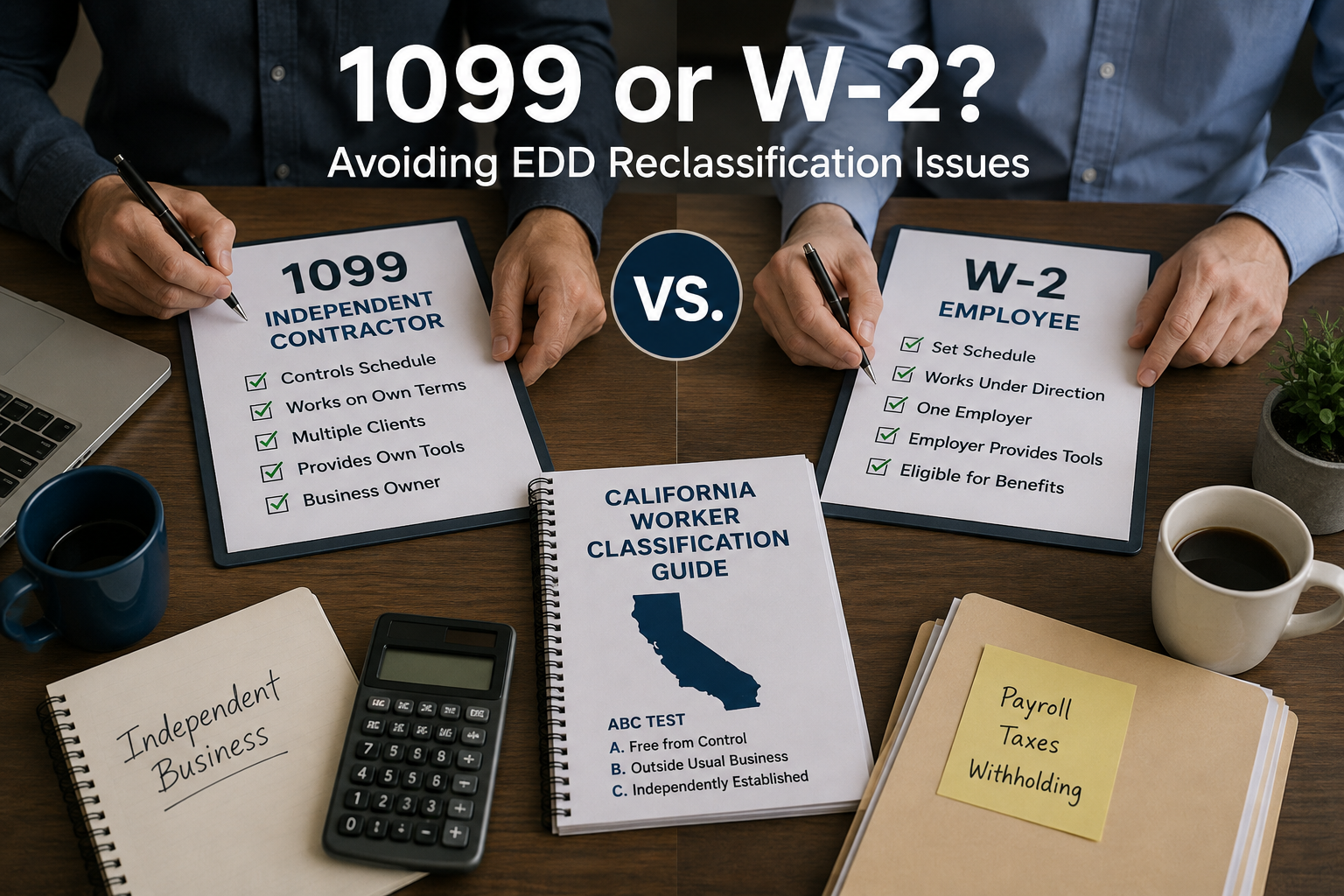
Read 1099 or W-2? Avoiding EDD Worker Reclassification in California.
One Worker Can Affect the Scope of the Audit
A classification question involving one worker can cause an auditor to examine other individuals performing similar services under similar arrangements.
Documentation Matters
Written agreements are helpful, but the complete factual record matters more than a contract alone. Invoices, payment histories, general ledger records, business documentation, and evidence concerning how services were actually performed can all become important.
Address Audit Issues Before They Become Final
The audit itself provides an opportunity to clarify facts, provide missing documentation, reconcile accounting records, and address disputed findings.
If a disagreement cannot be resolved during the examination and an assessment is issued, formal administrative appeal rights may be available.
Learn more about EDD Audit Appeals and Petitions for Reassessment.
CPA Representation for California EDD Payroll Tax Audits
EDD payroll tax audits often combine worker classification questions with detailed accounting analysis.
Boulanger CPA and Consulting PC provides CPA-led representation for California businesses facing EDD payroll tax examinations.
Representation may include:
- Reviewing the audit notice and scope
- Communicating with the EDD auditor
- Reviewing payroll and accounting records
- Analyzing Forms 1099 and contractor payments
- Reviewing worker classification issues
- Preparing for EDD audit interviews
- Reviewing proposed payroll tax adjustments
- Preparing accounting schedules and supporting documentation
- Developing support for disputed audit findings
- Assisting with administrative appeals when appropriate
For a broader overview of the audit process, visit our California EDD Payroll Tax Audit Guide.
Facing a California EDD Payroll Tax Audit?
If the EDD is questioning your independent contractors, payroll reporting, or worker classifications, we can review the audit and help you understand the issues and available next steps.
Schedule an EDD Audit ConsultationFrequently Asked Questions About EDD Payroll Tax Audit Assessments
Can an EDD payroll tax audit assessment be reduced?
Potentially. The result depends on the facts of the case. Worker classification conclusions, included workers, payroll amounts, tax periods, accounting errors, penalties, and supporting records can all affect the final liability.
Does one misclassified contractor mean every contractor will be treated as an employee?
Not necessarily. Each worker relationship should be evaluated under the applicable California classification standard and the facts surrounding the services performed. Workers operating under similar arrangements, however, may raise similar classification issues.
Can I dispute the EDD's payroll calculations?
Yes. Audit calculations can be reviewed for issues such as workers included, compensation amounts, periods, accounting treatment, taxes, and penalties. Supporting records may be used to challenge inaccurate adjustments.
How far back does an EDD payroll tax audit normally go?
EDD employment tax audits generally cover the 12 most recently completed calendar quarters, although an examination can expand and may extend further in some circumstances.
What records are important in a worker classification audit?
Relevant records may include Forms 1099, contractor agreements, invoices, payment records, general ledger detail, payroll records, tax returns, and documentation concerning how workers actually performed services.
Can I appeal an EDD payroll tax assessment?
California provides administrative procedures for challenging qualifying EDD employment tax assessments. The applicable notice and deadline should be reviewed promptly if the business disagrees with the assessment.