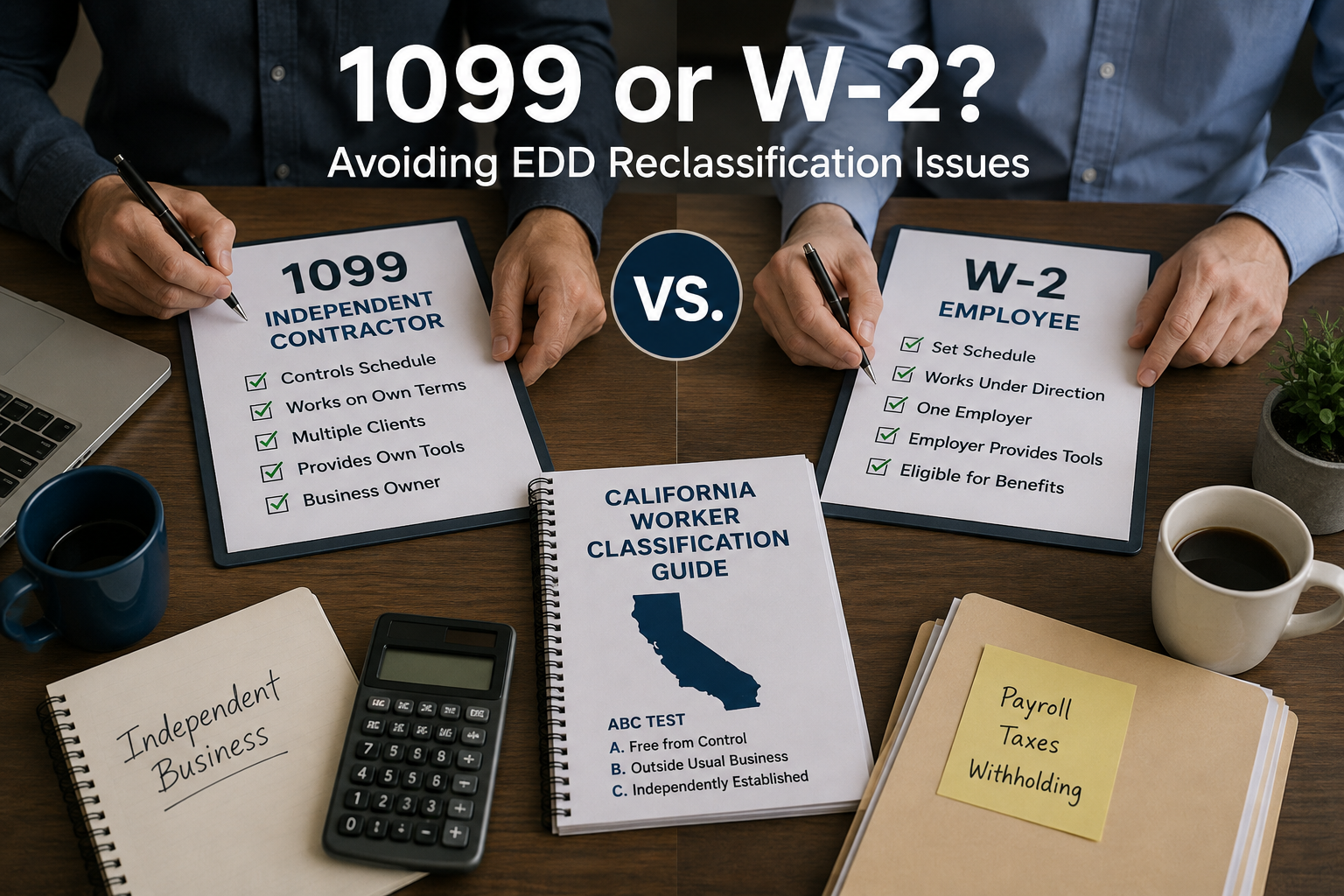


A California Employment Development Department payroll tax audit can place a significant burden on a business. The auditor may examine payroll reporting, payments to independent contractors, worker classification, accounting records, tax returns, and other information covering several years.
The best way to approach an EDD audit is not to panic and not to simply send every requested document without first understanding what the records show. A business should know the scope of the examination, identify potential problem areas, organize its records, and respond accurately to the issues the auditor is actually examining.
This guide explains how the EDD audit process generally works, mistakes to avoid, how worker classification can affect the examination, and what California employers can do to put themselves in a stronger position during the audit.
If you are still trying to understand why your business may have been selected, start with our guide to EDD payroll tax audit triggers.
Why Is My Business Being Audited by the EDD?
There is no single reason every EDD audit begins. The Department conducts employment tax audits to verify compliance with California employment tax law, determine whether workers were properly classified, and determine whether payments to employees were properly reported.
Issues that may become relevant include:
- Independent contractors and worker classification
- Payments reported on Forms 1099 rather than through payroll
- Late, missing, or inconsistent payroll tax filings
- Differences between payroll records and accounting records
- Information concerning a worker's employment relationship
- Unreported or potentially underreported wages
- Other information identified through the EDD's compliance activities
Receiving an audit notice does not by itself mean the EDD has already concluded that your business owes additional tax.
How Far Back Does an EDD Audit Usually Go?
EDD guidance states that employment tax audits generally cover a three-year statutory period consisting of the 12 most recently completed calendar quarters.
The audit commonly begins with a test year, generally the most recently completed calendar year. Depending on what the auditor finds, the examination may expand to the rest of the statutory audit period and, in some circumstances, beyond it.
This makes the initial portion of the audit important. An issue involving one worker, one account, or one period may cause the auditor to examine similar transactions in additional periods.
Step by Step: What Happens During a California EDD Audit?
1. You Receive an EDD Audit Notice
The process generally begins when the EDD notifies the business that it has been selected for an employment tax examination.
The correspondence should be reviewed carefully to identify:
- The audit period
- The assigned auditor
- Records initially requested
- Response dates or scheduled meetings
- Any specific issues already identified by the EDD
2. The EDD Conducts an Entrance Interview
EDD guidance provides for an entrance interview with the employer or the employer's designated representative before the auditor begins reviewing the records.
The auditor may use this discussion to learn about:
- The nature and organization of the business
- The accounting system
- The payroll process
- The types of workers used by the business
- Independent contractors and other nonemployee service providers
- How particular payments are recorded
Business owners should be prepared to answer accurately. If information needs to be researched, it is generally better to verify the facts than to guess.
3. Records Are Produced and Examined
The EDD may request payroll, accounting, tax, and worker-related records. The exact request depends on the business and the scope of the examination.
Records can include:
- Payroll registers and payroll journals
- California payroll tax returns
- Forms W-2 and 1099
- General ledgers
- Financial statements
- Federal and California income tax returns
- Check registers and disbursement records
- Independent contractor agreements
- Invoices and payment documentation
- Information concerning the services performed by workers
The auditor may compare information from different sources. For example, contractor payments recorded in the general ledger can be compared with Forms 1099 and information concerning how the workers actually performed services.
4. Worker Classification Issues Are Examined
If the business uses independent contractors, the auditor may examine whether particular workers should instead have been treated as employees.
The fact that a worker received a Form 1099 or signed an independent contractor agreement does not by itself determine the worker's status.
California generally applies the ABC test to many worker relationships, subject to statutory exceptions under which the Borello test or another standard may apply.
For a deeper explanation, see our California EDD Worker Classification Audit Guide.
5. The Auditor Develops Findings
As the examination progresses, the EDD may identify payments it believes should have been treated differently, workers it believes were improperly classified, or other payroll reporting issues.
This is an important point in the audit because the business may need to provide additional documentation, clarify facts, reconcile accounting information, or challenge conclusions it believes are unsupported.
6. The Audit May Result in an Assessment
If the EDD concludes that additional California employment taxes are due, the audit may result in an assessment that includes additional tax, interest, and applicable penalties.
The amount can become significant when an issue affects multiple workers or extends across several quarters.
What Is the EDD Looking for in Your Records?
Although every audit is different, the examination can focus on whether:
- All taxable wages were properly reported
- Payments to employees were properly included in payroll
- Independent contractors were properly classified
- Forms 1099 agree with accounting and payment records
- Payroll returns agree with underlying payroll records
- Payments outside the normal payroll system should have been treated as wages
- Workers performing similar services were treated consistently
The audit should therefore be viewed as more than a review of DE 9 filings. It can become an examination of how the business actually compensates and works with the people providing services.
Common Mistakes Businesses Make During an EDD Audit
Responding Before Understanding the Scope
Before responding to a substantial records request, understand the audit period, the documents requested, and whether worker classification or another particular issue appears to be driving the examination.
Sending Disorganized Records
A large collection of unexplained records can create unnecessary confusion. Records should be organized, reviewed for completeness, and reconciled where appropriate before production.
Ignoring Contractor Payments
If your general ledger contains substantial contractor or outside-services accounts, review those payments before the auditor does. Understand who was paid, what services were performed, and how those workers were classified.
Assuming a 1099 Settles the Classification Question
Form 1099 reporting does not establish that someone was legally an independent contractor. The underlying relationship and applicable California classification standard matter.
Guessing During an Auditor Interview
Audit questions should be answered accurately. If the answer requires reviewing records or speaking with someone who knows the facts, verify the information rather than making an assumption.
Waiting Until an Assessment Is Issued
It may be more difficult to develop the factual record after the auditor has completed the examination. Potential classification, payroll, and accounting issues are usually better identified while the audit is still underway.
What Should You Do Before Sending Records to the EDD?
You should comply with legitimate EDD audit requests. That does not mean records should be forwarded without first understanding them.
Before producing significant records, consider:
- Confirming the audit period
- Reviewing the exact records requested
- Reconciling payroll reports to accounting records where appropriate
- Reviewing Forms W-2 and 1099
- Identifying significant payments outside payroll
- Reviewing independent contractor accounts
- Identifying missing records before production
- Understanding potential worker classification issues
- Organizing the response so the records are understandable
The purpose of this review is not to hide information. It is to provide accurate and responsive records while understanding what those records may show.
What if the EDD Says Your Independent Contractors Were Employees?
If workers are reclassified as employees, payments made to them may be treated as wages for California employment tax purposes.
Depending on the facts, the resulting liability may include additional employment taxes, interest, and applicable penalties.
The impact can multiply when:
- Several workers were treated under the same contractor model
- The same practice continued for multiple years
- Contractor payments were substantial
- Several worker categories are under examination
A classification adjustment should be reviewed worker by worker and issue by issue. The applicable legal standard, underlying facts, workers included, periods involved, and EDD calculations can all matter.
Can You Dispute the EDD Auditor's Findings?
Yes. An auditor's findings do not necessarily end the matter.
Depending on the stage of the case, disputed issues may include:
- Worker classification
- Whether particular payments were wages
- Which workers should be included in an adjustment
- The amount of payroll attributed to particular periods
- Accounting or calculation errors
- Penalties
- Other factual conclusions reached during the audit
If an assessment is ultimately issued, California provides an administrative process through which an employer may challenge qualifying employment tax assessments.
Learn more about EDD audit appeals and Petitions for Reassessment.
A Practical EDD Audit Survival Plan
If your business is already under audit, focus on the things you can control:
- Read the notice carefully. Confirm the period, auditor, requested records, and response dates.
- Understand your workforce. Identify employees, independent contractors, commissioned workers, subcontractors, and other service providers.
- Review contractor payments. Know who received Forms 1099, what services they performed, and how the relationship operated.
- Reconcile the records. Compare payroll filings, accounting records, tax returns, Forms W-2, Forms 1099, and significant disbursement accounts.
- Prepare for auditor questions. Know how your payroll and contractor systems actually work before trying to explain them.
- Keep responses organized. Provide responsive records in a format that can be understood.
- Address disputed findings while the audit is active. Do not assume an incorrect conclusion will fix itself later.
- Protect formal appeal rights. If an assessment is issued, pay close attention to the notice and applicable deadlines.
How CPA Representation Can Help During an EDD Audit
EDD audits combine payroll reporting, accounting records, worker classification, tax compliance, and potentially significant financial exposure.
Boulanger CPA and Consulting PC provides CPA-led representation for California businesses facing EDD payroll tax audits.
Our work may include:
- Reviewing the EDD audit notice
- Identifying the scope and potential issues
- Communicating with the EDD auditor
- Reviewing payroll and accounting records
- Analyzing Forms 1099 and contractor payments
- Evaluating worker classification issues
- Helping organize records before production
- Reviewing proposed audit adjustments
- Developing support for disputed findings
- Assisting with administrative appeals when necessary
For a complete overview of our EDD audit representation, visit our California EDD Payroll Tax Audit Guide.
Facing an EDD Audit?
Whether your audit has just started or the EDD is already questioning payroll, independent contractors, or worker classification, we can help you understand where the case stands and what needs to happen next.
Schedule an EDD Audit ConsultationFrequently Asked Questions About Surviving an EDD Audit
Why is my business being audited by the EDD?
There is no single reason every audit begins. The EDD may examine worker classification, independent contractor payments, payroll reporting, discrepancies among business records, or other employment tax compliance issues.
How far back does an EDD audit usually go?
EDD guidance states that employment tax audits generally cover the 12 most recently completed calendar quarters, although the examination may expand and may extend further in some circumstances.
What records does the EDD request during an audit?
Depending on the audit, requested records may include payroll registers, payroll tax returns, Forms W-2 and 1099, general ledgers, financial statements, tax returns, disbursement records, contractor agreements, invoices, and information concerning worker relationships.
Should I speak with the EDD auditor myself?
A business owner may communicate directly with the auditor, but responses should be accurate and informed. If a question requires research, review the records before answering rather than guessing. A taxpayer may also use an authorized representative in appropriate EDD matters.
What happens if the EDD reclassifies my independent contractors?
Payments to reclassified workers may be treated as wages for California employment tax purposes. Depending on the facts and periods involved, additional employment taxes, interest, and applicable penalties may result.
Can I challenge an EDD audit assessment?
Yes. California provides administrative procedures for disputing qualifying EDD employment tax assessments. The notice and applicable deadlines should be reviewed promptly if you disagree with the EDD's findings.
Can a CPA represent my business during an EDD audit?
Yes. A CPA can represent a business in appropriate EDD employment tax matters and assist with auditor communications, accounting and payroll records, worker classification issues, audit adjustments, and administrative disputes.
Explore more California EDD audit resources for guidance on payroll tax audits, worker classification, assessments, and appeals.