

If your business has received an audit notice from the California Employment Development Department, one of your first questions may be: How long is this going to take?
There is no single timetable for an EDD payroll tax audit. Some examinations are relatively straightforward, while others take considerably longer because of extensive records, worker classification disputes, multiple categories of independent contractors, missing information, or disagreements over the auditor's findings.
The more useful question is not simply how many months an audit will take. It is what stage your audit is in, what issues remain unresolved, and what may be causing the examination to continue.
This guide explains the stages of an EDD employment tax audit, the factors that can make an audit longer, and what California business owners can do to keep the process organized.
Is There a Standard Length for an EDD Payroll Tax Audit?
EDD does not publish a standard number of days or months in which every employment tax audit must be completed.
The duration depends on the facts of the business and the scope of the examination. A business with a straightforward payroll system, complete records, and few disputed issues may move through the process differently from a business with large independent contractor populations, multiple entities, incomplete books, or contested worker classifications.
An audit may also continue longer when the auditor requests additional records, expands testing, seeks information concerning particular workers, or when the employer challenges preliminary findings.
How Many Years Does an EDD Audit Cover?
EDD guidance states that employment tax audits generally cover a three-year statutory period consisting of the 12 most recently completed calendar quarters.
The EDD commonly begins by examining records for a test year, generally the most recently completed calendar year. Depending on what the auditor finds, the examination may then be expanded to the entire audit period.
In some circumstances, the EDD may examine periods beyond the ordinary three-year statutory period. The scope depends on the filing history and issues involved.
This distinction is important. The fact that the audit covers three years does not mean the auditor will spend the same amount of time reviewing every quarter. The examination may begin with selected periods and expand when discrepancies or classification issues are identified.
The Stages of an EDD Audit and What Can Affect the Timeline
1. Audit Notice and Initial Preparation
The audit begins with notice from the EDD and an initial request for records or information.
At this stage, the business should identify:
- The audit period
- The records requested
- The assigned auditor
- Important response dates
- Whether independent contractors or worker classification issues appear to be involved
Delays can begin immediately if the requested records are difficult to locate, accounting information must be reconstructed, or the scope of the request needs clarification.
2. Entrance Interview
Before reviewing the records, EDD guidance provides for an entrance interview with the employer or the employer's designated representative.
During this stage, the auditor may gather information about the business, its ownership, accounting system, payroll process, workers, and general operations.
A well-prepared entrance interview can help establish an accurate understanding of the business at the beginning of the examination.
3. Examination of Payroll and Accounting Records
The records examination is often the most time-consuming part of an EDD audit.
The auditor may review or compare:
- Payroll registers and payroll journals
- California payroll tax returns
- Forms W-2 and 1099
- General ledgers
- Financial statements
- Federal and California income tax returns
- Check registers and disbursement records
- Independent contractor payments
- Contracts and invoices
- Other documents concerning individuals who performed services
The audit can take longer when information from different systems does not reconcile or when additional records must be obtained to explain differences.
4. Worker Classification Review
Worker classification issues can significantly increase the complexity of an EDD audit.
The auditor may need to understand not only how workers were paid, but also what services they performed and how the relationship actually operated.
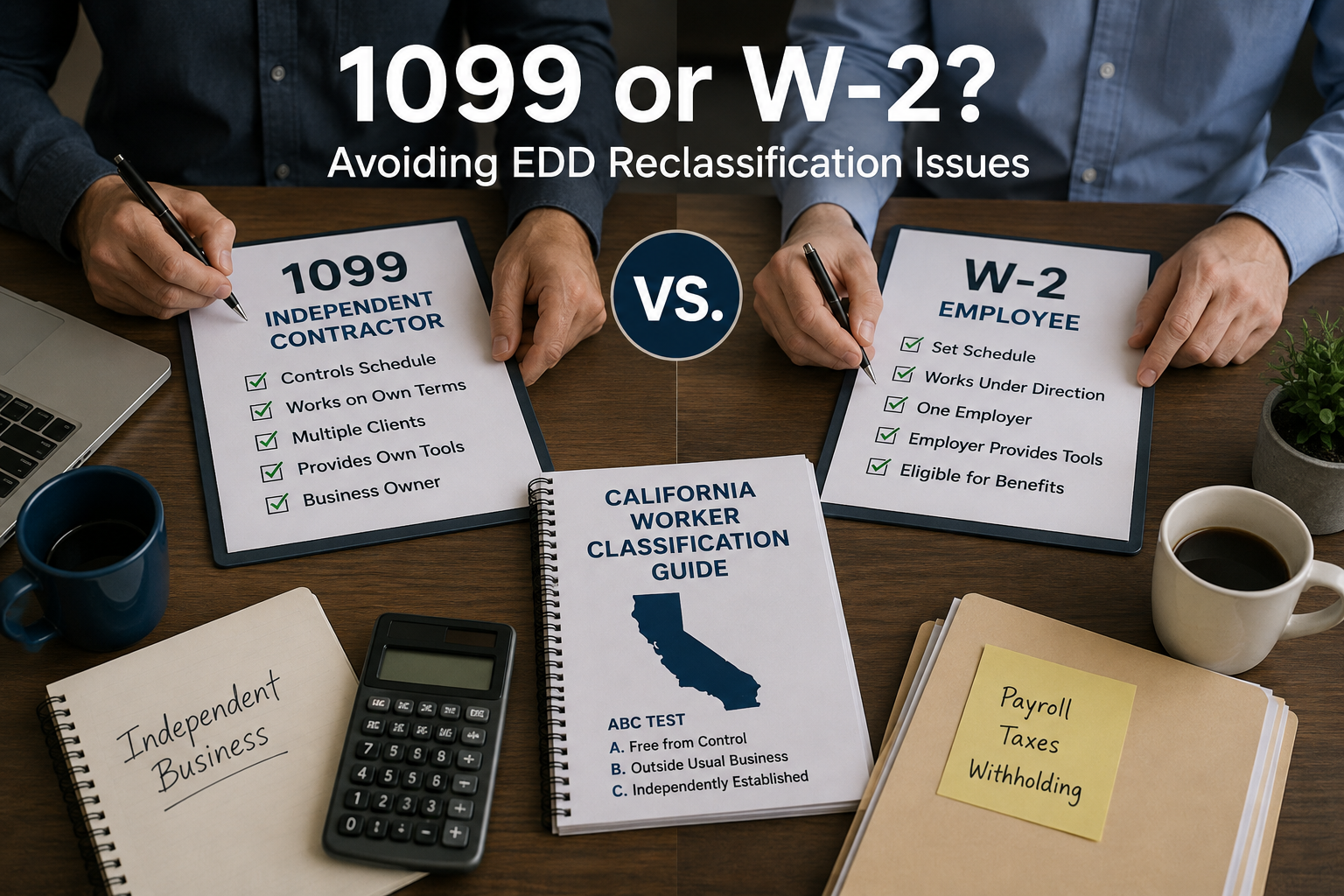
Depending on the facts, the EDD may review contracts, invoices, Forms 1099, payment records, the degree of control exercised by the business, whether the worker operated an independent business, and other facts relevant to the applicable California classification standard.
When many workers were treated under the same contractor model, the classification review may involve an entire group rather than a single individual.
Learn more in our EDD Worker Classification Audit Guide.
5. Additional Information Requests
An initial records request does not necessarily represent everything the auditor will eventually want to examine.
As questions develop, the auditor may ask for additional accounting records, worker documentation, contracts, invoices, explanations, or reconciliations.
Each additional request can extend the timeline, particularly when the requested information must be reconstructed or obtained from third parties.
6. Audit Findings and Employer Response
Once the auditor develops findings, the employer may need to review the proposed adjustments and determine whether the factual conclusions and calculations are accurate.
Disputed issues can include:
- Worker classification
- Whether particular payments constitute wages
- Which workers should be included in an adjustment
- The periods included in the calculation
- Accounting differences
- The amount of payroll used in the assessment
- Penalties or other components of the proposed liability
Resolving these issues before the audit closes can add time to the examination, but additional time is not necessarily a bad thing when it is being used to correct or properly document a disputed issue.
7. Assessment and Appeal, if Necessary
If the EDD issues an assessment and the employer disagrees with it, the dispute can continue beyond the audit itself.
California employers may have the right to challenge qualifying EDD assessments through a Petition for Reassessment and the California Unemployment Insurance Appeals Board process.
An administrative appeal is a separate procedural stage and can substantially extend the total amount of time before the matter is finally resolved.
For more information, see our California EDD Audit Appeals Guide.
What Can Make an EDD Audit Take Longer?
Several factors can increase the time required to complete an employment tax audit.
- Incomplete or missing payroll and accounting records
- Large numbers of independent contractors
- Multiple categories of workers with different working arrangements
- Worker classification disputes
- Differences between Forms 1099, payroll records, tax returns, and the general ledger
- Multiple business entities or related companies
- Changes in ownership or entity structure
- Requests for additional records
- The need to reconstruct payroll or payment information
- Disagreement over preliminary audit findings
- Changes in the personnel assigned to the examination
- An administrative appeal after an assessment is issued
Why Independent Contractors Can Extend an EDD Audit
Contractor-heavy businesses can require more factual development than businesses whose workforce consists almost entirely of clearly identified W-2 employees.
If the auditor identifies significant payments to individuals outside payroll, the examination may move beyond the accounting records and into questions about the actual working relationships.
For each category of worker, questions may arise about:
- The services performed
- How the work was directed or controlled
- Whether the services were part of the business's usual operations
- Whether the worker maintained an independently established business
- Whether similarly situated workers were treated consistently
- Which California worker classification test applies
If the same issue potentially applies to dozens of workers, the audit can naturally require more time.
Can You Make an EDD Audit Move Faster?
You cannot control the EDD's workload or force an auditor to complete an examination on a particular schedule. You can, however, avoid creating unnecessary delays.
Organize Records Before Producing Them
Responsive and understandable records are easier to examine than a large unorganized document dump. Review records for completeness and identify missing information before production.
Reconcile Obvious Differences
If payroll reports, Forms 1099, general ledger accounts, or tax returns contain differences, understand those differences before the auditor asks about them.
Respond Accurately
Avoid guessing in response to auditor questions. If information must be researched, verify the records and provide an accurate response.
Identify Worker Classification Issues Early
If contractor classification is likely to become a significant issue, identify the workers, agreements, payments, and relevant facts early rather than waiting until the auditor develops conclusions.
Keep Track of Open Requests
Maintain a record of what the EDD requested, what was provided, when it was provided, and what questions remain unresolved.
Finishing the Audit Quickly Is Not Always the Most Important Goal
Business owners understandably want an audit finished as quickly as possible. But speed should not come at the expense of accuracy.
If the auditor has reached a conclusion that the business believes is incorrect, additional time may be necessary to locate documents, reconcile records, develop worker classification facts, or prepare accounting schedules.
The goal should be an organized and supportable resolution of the examination, not simply getting the audit closed as fast as possible.
What if Your EDD Audit Seems to Be Going Nowhere?
Long periods without visible activity can be frustrating, but it is important to determine whether the delay is actually preventing the case from progressing.
Useful questions include:
- Does the auditor still need records from the business?
- Are there unanswered questions?
- Is worker classification still under review?
- Has the auditor provided preliminary findings?
- Are calculations or workpapers still being developed?
- Has the case been reassigned?
- Is the audit actually complete but awaiting an assessment or another procedural step?
Knowing the precise status of the case is often more useful than simply asking how long the audit has been open.
How CPA Representation Can Help Manage an EDD Audit
A CPA cannot control the EDD's schedule, but professional representation can help keep the employer's side of the audit organized and responsive.
Boulanger CPA and Consulting PC provides CPA-led representation for California businesses facing EDD payroll tax audits.
Our work may include:
- Reviewing the audit notice and scope
- Communicating with the EDD auditor
- Tracking records requests and responses
- Reviewing payroll and accounting records
- Reconciling information before production
- Analyzing Forms 1099 and contractor payments
- Evaluating worker classification issues
- Reviewing proposed audit adjustments
- Developing documentation supporting disputed findings
- Assisting with appeals when an assessment remains disputed
For a broader overview of the examination itself, see our California EDD Payroll Tax Audit Guide.
Is Your EDD Audit Taking Longer Than Expected?
Whether your audit has just started or has been open for months, we can help you understand what stage the examination is in, what issues remain unresolved, and what may need to happen next.
Schedule an EDD Audit ConsultationFrequently Asked Questions About EDD Audit Timelines
How long does an EDD payroll tax audit take?
There is no standard completion time published by the EDD for every employment tax audit. The duration depends on the business, records, worker classification issues, scope of the examination, additional information requests, and whether the findings are disputed.
Does an EDD audit normally cover three years?
EDD guidance states that employment tax audits generally cover a three-year statutory period consisting of the 12 most recently completed calendar quarters. The examination can be expanded and may extend further in some circumstances.
Why is my EDD audit taking so long?
Delays can result from incomplete records, additional document requests, worker classification analysis, discrepancies among payroll and accounting records, multiple worker groups, disputed findings, or administrative delays.
Can independent contractors make an EDD audit take longer?
Yes. Independent contractor issues may require the auditor to examine the actual working relationships, contracts, payments, services performed, and the classification standard applicable to different workers.
Can I speed up my EDD audit?
You cannot control the EDD's schedule, but organized records, accurate responses, timely production of requested information, and early identification of classification or accounting issues can help avoid unnecessary delays.
Does an appeal count as part of the EDD audit timeline?
An administrative appeal occurs after the audit when an employer disputes a qualifying assessment. Although technically a separate procedural stage, it can significantly increase the total time before the employment tax matter is finally resolved.
Can a CPA represent my business during an EDD audit?
Yes. A CPA can represent a business in appropriate EDD employment tax matters and help manage auditor communications, records requests, accounting analysis, worker classification questions, audit adjustments, and administrative disputes.